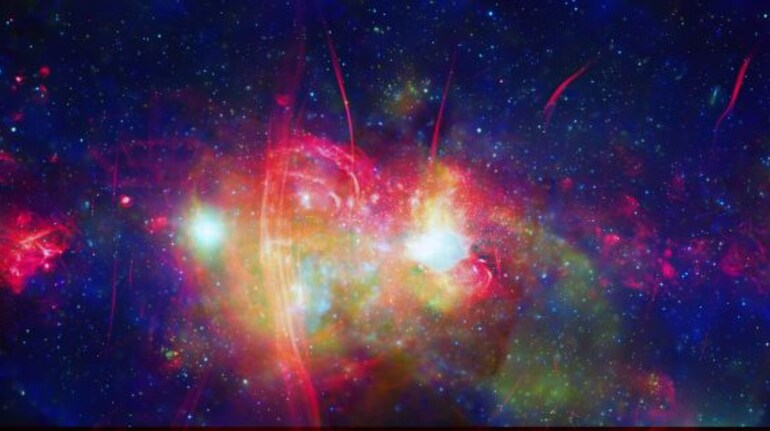
Scientists have found a bizarre phenomenon near the middle of our galaxy. Tornado-like narrow, long filaments of gas spin around the supermassive black hole in the Milky Way. These previously unseen structures could be key in the transport of gas in space.
Mysterious Filaments in a Region of TurbulenceThe Atacama Large Millimeter/submillimeter Array in Chile was used by astronomers. They examined a crowded region near the center of the galaxy known as the Central Molecular Zone. This place is filled with dust and gas and is constantly evolving and reforming. Clouds crash into each other at speeds of as much as 100 kilometers per second. Due to the crazy environment, it is difficult to study.
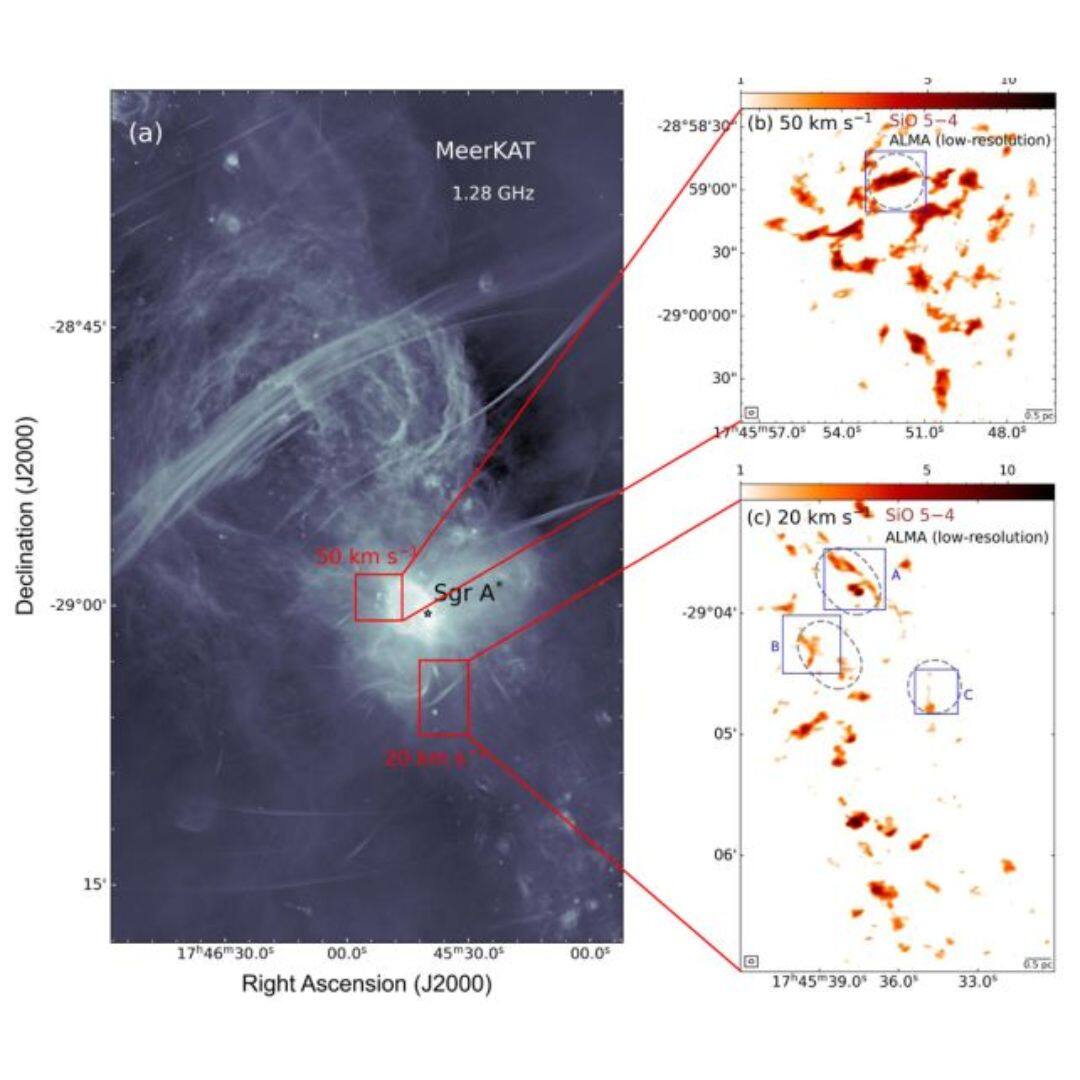 The slim filaments in the CMZ, with (b) and (c) displaying silicon monoxide intensity in each cloud. (Image: Yang et al., A&A, 2025)
Scientists found weird gas filaments during their experiments. The filaments had unusual velocity and were displaced from star-forming regions. They seemed to be driven by turbulence instead of gravity, unlike other structures. Scientists believe that these "slim filaments" behave like cosmic tornadoes.
How the Galaxy May Be Formed by These "Space Tornadoes"Silicon monoxide is one of the complex molecules present in the thin filaments. When it comes to monitoring shock waves in space, this molecule is crucial. These structures, scientists say, are a result of collisions within the CMZ. Turbulence is formed by shocks generated when clouds collide. Molecules dispersed into space through this process end up coming back as dust.
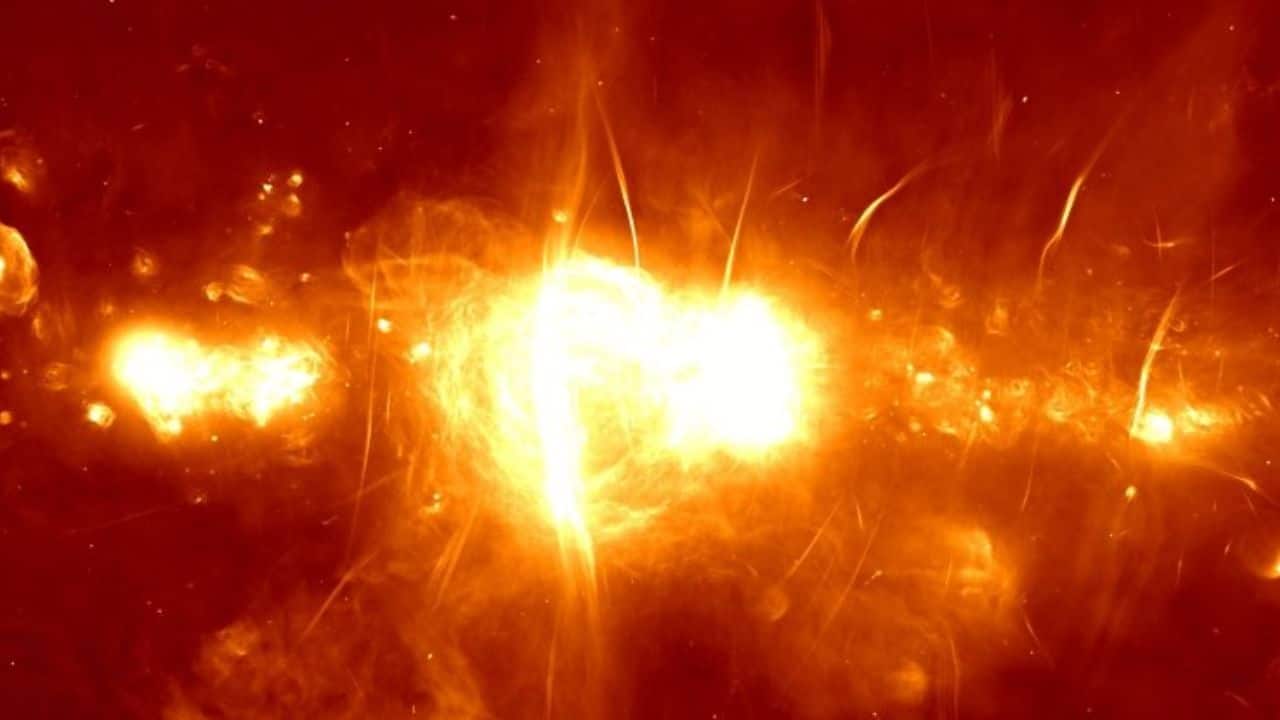 The galactic centre as seen through South Africa's MeerKAT radio telescope. (Image: SARAO)
Within 10,000 years, these filaments are likely to form, distribute material, and then vanish. Their role in redistributing gas could be critical to the formation of the CMZ. They could be the explanation for material recycling in the core of the galaxy if they are widespread throughout the region.
These filaments, as astronomers indicate, are different from the dense threads of gas that they find elsewhere. They could be the result of interactions between molecular clouds and shockwaves. As stated by a study published in Astronomy & Astrophysics, they enrich the interstellar medium. Scientists are presently trying to understand more about their formation and how they influence galactic dynamics.
Discover the latest Business News, Sensex, and Nifty updates. Obtain Personal Finance insights, tax queries, and expert opinions on Moneycontrol or download the Moneycontrol App to stay updated!
Find the best of Al News in one place, specially curated for you every weekend.
Stay on top of the latest tech trends and biggest startup news.