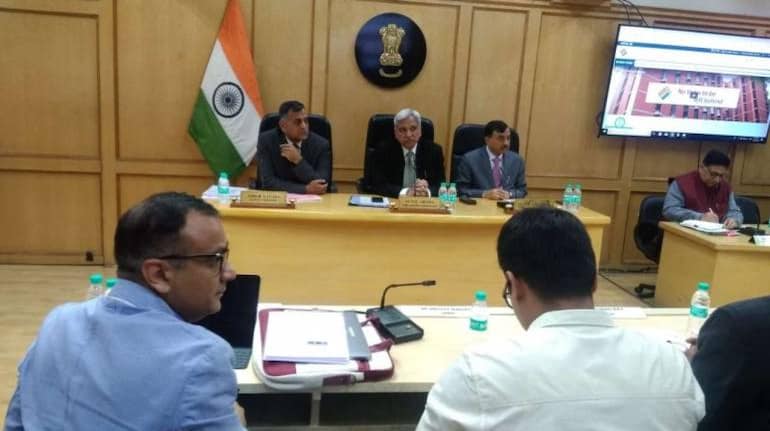
The pre-poll period of 2019 Lok Sabha elections witnessed a massive upheaval as reports and complaints against parties and candidates regarding violation of the Model Code of Conduct (MCC) during the pre-election campaigning.
Chief Election Commissioner (CEC) Sunil Arora had on March 10 listed out the regulations under the MCC, but little is known about the repercussions in case of violation.
MCC is a set of obligatory guidelines that need to be followed for fair passage of elections and are formulated with proper consensus of the parties contesting the polls.
The code basically runs on the goodwill of the contesting parties and candidates, to follow the guidelines and is fundamentally enrolled on principles and ethics, to uphold the faith and dignity of democracy.
However, a lot of contemplation has been going on over the Election Commission of India (ECI) actually penalising the violators. What we need to know here is that these code of conduct regulations are not necessarily bound by a legal frame work and hence penalising the parties or candidates does not sustain much of an imposition.
MCC is not admissible in the court of law as a wholesome rule book with penalties accorded. Warnings from CEC or the EC are mostly the first and the last step in curbing these violations, and in most cases these complaints are suspended.
However, certain provisions of the MCC can be administered legally by soliciting corresponding provisions in other ordinances. The violations need to conjure with statutes under the Indian Penal Code 1860, Code of Criminal Procedure 1973 and Representation of the People Act, 1951.
The Standing Committee on Personnel, Public Grievances, Law and Justice had steered for making the MCC legally bound in 2013. After failed recommendations on the matter, the Standing Committee concluded an observatory from a report on electoral reforms, that most of the provisions under the MCC, are coercion of corresponding provisions in other statutes mentioned above.
The ECI argues that “bringing the MCC on the statute book will only be counter-productive”, constricted due to various parameters.
The general elections continue for a period of 45 days and the electoral process is a continued incessant activity that needs to finish within the estimated period of time.
Judicial proceedings for these violations shall only increase the time frame causing an inevitable delay in the electoral process.
Under Article 324 of the Indian Constitution, the ECI is empowered to call upon any party or candidate, against whom a complaint has been lodged. All ruling and contesting parties must adhere to these norms.
In case of violation, the ECI commonly sends a "show cause notice" to the alleged party asking for valid reasoning as to why action is not to be taken against them, within the given time log. Failing this, the concerned party shall have to comply with proceedings of the ECI based on the previous merits of the complaint.
The ECI further appoints a committee to evaluate the conduct of the alleged party. With that being said, the ECI still does not have a judicial hand to penalise the violators.
On July 3, 2018 the EC launched the C-vigil application for citizens to report on matters of political misconduct pertaining to violation of the MCC.
The report must contain evidence in the form of videos or photographs and must necessarily be geo-tagged. The complaints filed are sent to the District Control room which then sends a surveillance squad with local police officers to investigate the matter.
Discover the latest Business News, Sensex, and Nifty updates. Obtain Personal Finance insights, tax queries, and expert opinions on Moneycontrol or download the Moneycontrol App to stay updated!
Find the best of Al News in one place, specially curated for you every weekend.
Stay on top of the latest tech trends and biggest startup news.